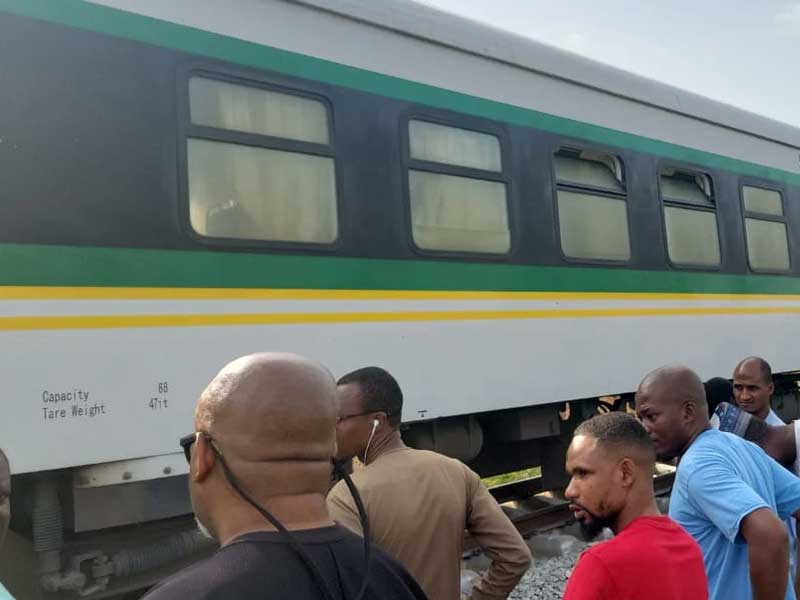
Passengers travelling on the Abuja–Kaduna Railway have recounted a series of distressing experiences, including alleged ticket racketeering, overcrowding and technical faults that disrupted their journey.
Some of the commuters who spoke in Abuja said what was expected to be a comfortable trip lasting about two hours turned into a difficult experience that lasted more than three and a half hours.
Several passengers also claimed that attendants had to pour buckets of water on an overheating power unit during the trip, a situation they said repeatedly caused the train’s cooling system and lighting to shut down temporarily.
Allegations of Ticket Racketeering
One passenger, Solomon Abiona, told reporters that his challenges began days before his trip when he attempted to purchase tickets through the booking platform of the Nigerian Railway Corporation.
According to him, he repeatedly tried to secure five tickets for companions travelling with him from Abuja to Kaduna but found that all seats were already booked on the official platform.
Abiona said a frequent traveller later introduced him to someone he described as a ticket racketeer who allegedly arranged tickets at a higher price.
He explained that each ticket was sold for ₦6,000, significantly above the official fare of ₦3,600, and the tickets issued carried different names.
He further stated that during the return trip from Kaduna to Abuja, he and his companions received tickets without seat numbers and were instructed to occupy any available seat.
“When the passengers assigned to those seats arrived, we had no option but to stand in the aisle for more than three hours,” he said.
Overcrowding and Reduced Train Trips
Another commuter, Ibrahim Bulus, said the situation becomes more challenging during weekends when passenger demand is higher.
According to him, overcrowding worsened after the number of daily train services along the route was reduced from six trips to two.
He called on the railway management to increase the number of trips in order to meet growing demand along the busy corridor.
Mechanical Concerns During the Journey
Passengers also expressed concern about technical issues observed during the trip.
Some travellers claimed the train slowed down significantly after the power unit overheated, with attendants seen pouring water on it to cool it down.
A first-time passenger on the route, Chief John Fabunmi, said the experience left him both disappointed and frightened.
Fabunmi said more than 100 passengers were standing inside the coaches due to the lack of seats.
“When the pain became unbearable, I had to sit on my luggage at the rear of the coach,” he said.
He added that each time the power unit overheated and the cooling system shut down, the train slowed to what he described as a “snail’s pace,” raising fears about safety along the route.
Comparisons With Other Rail Systems
Another commuter, Wusi Lawrence, lamented that the service on the Abuja–Kaduna rail line was not significantly different from the narrow-gauge railway operations that existed decades ago.
He noted that rail systems in several other countries, including South Africa and Kenya, have advanced significantly with faster trains and improved passenger comfort.
According to him, many countries are now operating high-speed rail services, while Nigeria’s system continues to face operational challenges.
NRC Responds to Allegations
Responding to the complaints, Abubakar Bunma, media aide to the Managing Director of the Nigerian Railway Corporation, Kayode Opeifa, said the corporation does not issue tickets without seat numbers.
Bunma explained that tickets purchased through the official system are automatically generated and include details such as the passenger’s name, phone number and National Identification Number.
He acknowledged that technical issues could occasionally lead to failed bookings, where passengers might be debited without confirmation.
In such situations, affected travellers who arrive at the station may have their trips rescheduled or be allowed to travel if seats become available.
Clarification on Overheating Reports
Bunma also clarified that reports of water being poured on the train engine were inaccurate.
According to him, the water was used to cool the power car generator responsible for providing electricity to the train’s lighting, air-conditioning and other onboard services.
“If the locomotive engine stops, the train cannot move. What people saw being cooled was the generator inside the power car,” he said.
Plans to Improve Services
He added that the corporation does not permit standing passengers on long-distance journeys and insisted that ticket sales are aligned with the train’s seating capacity.
Bunma also explained that the duration of the Abuja–Kaduna journey was extended from 2.5 hours to about three hours following a rail accident in August 2025 as part of new safety measures.
He revealed that the management of the Nigerian Railway Corporation is working to increase daily trips on the corridor from one to three or four in order to meet passenger demand.
Growing Concern Among Commuters
Despite the explanations from the rail authority, many passengers say their experiences point to deeper operational challenges affecting the service.
For many Nigerians, the Abuja–Kaduna railway was expected to provide a safer and more efficient alternative to road travel between the two cities.
However, travellers say issues such as overcrowding, alleged corruption and mechanical concerns continue to undermine public confidence in the rail service.
Stakeholders have therefore called for improved ticketing systems, stricter monitoring of staff conduct and stronger maintenance protocols to restore trust in the corridor.